
72. When Should You Start HRT? The Truth for Women in Their 40s
Don’t Miss An Episode!





Confused about when to start hormone replacement therapy? You’re not alone. In this episode of Perimenopause Simplified, we’re cutting through the mixed messages and breaking down when to consider starting HRT, what symptoms to look out for, and how to know if it’s the right move for you.
If you’re in your 40s and feeling dismissed, overwhelmed, or unsure where to begin…this one’s for you.
We cover:
- Why hormone replacement therapy (HRT) is so confusing and what’s changed since the 2002 WHI study
- The difference between perimenopause and menopause & why that matters for HRT timing
- Common early symptoms that may signal hormone shifts (and which hormone to start with first)
- When estrogen might be added – it’s earlier than you think
- The risks of waiting too long to start HRT
- Why and when I started HRT myself
Sources:
Hormone Therapy & Cardiovascular Disease: The Role of Timing
To learn about hormone therapy, grab Claudia’s brand new, FREE resource: 3-Day HRT Crash Course.
In just 3 quick emails, you’ll learn:
📌 What HRT is + how it works to improve symptoms
📌 The different types + how to choose for you
📌 Common mistakes (and how to avoid them)
Feeling Confused About HRT Timing? You’re Not Alone
If you’ve been wondering when to start hormone replacement therapy or feeling totally overwhelmed by the conflicting opinions out there, you’re not alone.
Many providers say, “You don’t need it, wait until menopause, you’re still getting a period or it’s harmful.” Meanwhile…you’re waking up at 3 a.m., gaining weight for no reason, crying at the drop of a hat, and wondering what the hell is happening to your body.
Today, I’m going to give you a simple, no-fluff answer to one of the most common questions I get: “When should I start HRT?” And even more importantly — how do you know if it’s right for you?
The Confusing Landscape Around HRT
Hormone therapy has become this weird battleground — between outdated research, poorly educated providers, and social media influencers shouting about pellets or shots.
And us ladies are caught in the middle — feeling dismissed, confused, and often… just told to wait it out.
The Study That Changed Everything (and Misled Millions)
The biggest reason HRT still feels like a mystery is because of the Women’s Health Initiative from 2002. It was a massive study, but it used women who were postmenopausal, with other health issues, and synthetic hormones — the results were blown way out of proportion.
And that study led millions of women (and their doctors) to believe HRT was dangerous, especially for heart health and breast cancer risk.
What We Know Now About Bioidentical Hormones
But more recent research has shown that bioidentical hormones, those that mimic the same molecular structure as the hormones your body makes — especially topical estrogen and oral progesterone — are not only safe, but actually protective when started at the right time.
But that brings us to the next question: what is the right time?
Perimenopause Is the Window
If you’re in your 40s and experiencing perimenopausal symptoms, this is the window.
Perimenopause is the 5–10+ year before menopause — and your hormones are already fluctuating like crazy. You know this, because you likely can FEEl it.
And you don’t have to wait until your period stops to start hormone therapy. That’s outdated advice. In fact, waiting too long to start HRT — especially estrogen — can reduce some of the protective benefits for your heart, brain, bones, and skin.
It’s Not About Age — It’s About Symptoms
Now, to be clear: You don’t need to start HRT the moment you turn 40. It’s not about your age necessarily — it’s about your symptoms and quality of life.
Ask yourself:
-
Are you waking up between 2–4 a.m. and can’t get back to sleep?
-
Are you crying for no reason or dealing with rage that feels out of character?
-
Are your periods heavier, longer, or completely unpredictable?
-
Are you dealing with anxiety that doesn’t respond to your usual tools?
-
Are you dealing with brain fog, can’t focus and your work is impacted?
Start With Progesterone First
These are signs that hormones are declining, especially progesterone — for most women, that’s the first hormone worth addressing.
Oral micronized bioidentical progesterone — in a capsule — can be a game changer for sleep, anxiety, and mood regulation. If the FDA-approved capsule doesn’t work for you, you may need a compounded formula or a troche that slowly dissolves in your mouth. The good news is there are a variety of options, dosing and formulas to fit each woman.
When to Add Estrogen
Then, as you get closer to menopause (when your cycles are spacing out), estrogen is typically the next to be added. Transdermal estrogen — through a patch, gel, cream or spray — is considered safest and most effective. However, you can start earlier than that if needed.
I personally started HRT before 40, dabbling over the counter low-dose options before I decided to get prescription hormones from my doctor. I had changes in my sleep, my mood, my periods, I dealt with joint pain, anxiety and brain fog.
Like many of our clients, I didn’t want to wait until things got worse. I mean hello, look at what I do for a living. Could you imagine continuing down that path? I assure you I wouldn’t be doing this podcast if I still felt that way.
You’re Not Too Young — You’re Ready for Support
Most of the women we support begin HRT between ages 40–45, because their symptoms start affecting their quality of life. So no, you’re not too young. You just need the right information and support.
The point is: you don’t need to wait until things are “bad enough.”
If your quality of life is declining and you’ve already dialed in sleep, nutrition, nervous system support — HRT may be the missing piece.
How to Know If This Is Your Next Step
So how do you decide if this is your next step?
Ask yourself:
-
Have I done the basics — eating enough protein, managing stress as best I could, creating better boundaries, moving my body, hydrating?
-
Have I ruled out thyroid or nutrient deficiencies? This is why we run an HTMA with all our clients as well as comprehensive blood work review — midlife is not just about hormones; we look at lipid markers to assess CVD health, inflammatory markers, immune health and much more
-
Do I feel dismissed when I ask for help or just handed birth control or an antidepressant?
HRT Is Not a Magic Bullet — But It Can Help You Feel Like You Again
If you’re nodding along…HRT might not be just “an option” — it may be the thing that finally helps you feel like yourself again.
And listen — it’s not magic. I say this over and over at the risk of sounding like a broken record. You still need to support your body holistically.
Eating a whole foods diet, prioritizing rest, minimizing alcohol, moving your body daily, assessing stress in your life — those are not optional. Because if you’re not doing those things, your HRT won’t be as effective and you may even feel worse.
But when the timing, dose, and delivery method are right — it can be quite life-changing, as it was for me.
Now Is the Time to Explore Your Options
So, if you’re in your 40s, feeling off, and wondering if it’s too early — it’s not.
In fact, this is the best time to explore your options — not wait until everything falls apart. We actually have clients in their 30s already starting HRT.
Want to Learn More?
If you want to learn more, my Perimenopause HRT Roadmap course is on sale this month — and it’s $100 off through July 31st with a special coupon code.
I break down all the types of HRT, what symptoms to look out for, how to talk to your provider, important testing to consider, and how to avoid the most common mistakes.
And if you want personalized support, you can also book a private session with me as an add-on. Everything is linked in the show notes, as usual.
Thanks for listening — and remember: you’re not crazy, you’re definitely not too young, you’re just in perimenopause.
I’ll see you next time.
Claudia Petrilli is a Functional Health Coach, Integrative Nutrition Coach, Women’s Health Educator, and creator of The Perimenopause Method. Having experienced debilitating periods, digestive issues, a sluggish thyroid, a pituitary tumor, and perimenopause symptoms in her late 30s, she knows exactly what it’s like to get dismissed by doctors and spend years searching for answers.
To connect with Claudia Petrilli:
To connect with Claudia Petrilli:
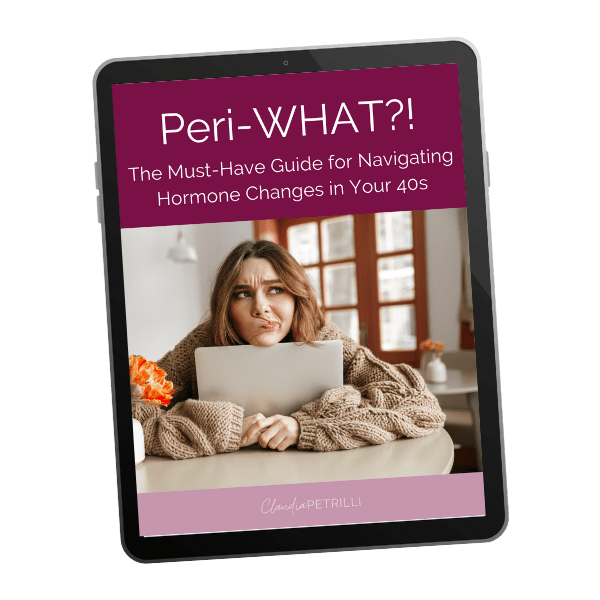
FREE GIFT: Peri-What?! The Must-Have Guide for Women 40+ Navigating Hormone Changes
FREE GIFT: Perimenopause Daily Checklist
WORK WITH US: The Perimenopause Method
BOOK A CLARITY SESSION: Perimenopause Clarity Session
HRT COURSE: Perimenopause HRT Roadmap
QUESTIONS? EMAIL: claudia@claudiapetrilli.com
Love the show? Please subscribe, leave a 5-star rating, review, and share, so that other women can find this podcast for guidance and support through their perimenopause journey!